You have to be in it to win it.
A leading physician practice management consultant called me today to ask about marketing a new Article 28 multi-specialty practice. I suggested to her that she look up the record on who was recently approved in NYS and to call them for their marketing plan. Are referrals still based on friendships or hospitall connections? Are Accountable Care Organizations or Insurance Plan Preferred Provider Organizations going to run the health care delivery system?
Here is the last chance for providers and others to be heard about how the ACA will be implemented in NYS. You or your organization can attend these meetings, no charge. lf you want your opinion in the record, make sure you put it in writing and send in advance or be there to testfy.
CON Redesign Special PHHPC Planning Committee,
PHHPC Committee and Full Council Meetings:
June – December 2012
6/21/12 – Albany Special Planning Committee: Driving Health System Improvement in New York State: Policy Priorities and Tools
7/25/12 – Albany Committee on Codes, Regulations, and Legislation
Committee on Public Health
Special Health Planning Committee: Innovations in Financing and Organizing Health Care: Implications for CON and Health Care Regulation
7/26/12 – Albany The Establishment and Project Review Committee
8/9/12 – Albany PHHPC Full Council
9/5/12 – Rochester Special Planning Committee: Regional Health Planning
9/19/12 – NYC Special Planning Committee: Establishment, Governance and Financial Feasibility
9/20/12 – NYC Regular PHHPC Committee
10/11/12 – NYC PHHPC Full Council
10/12/12 – NYC Special Planning Committee: Access and Public Need
10/30/12 – NYC Special Planning Committee: Review Draft Report
11/14/12 – Albany Special Planning Committee: Discuss Revised Report
11/15/12 – Albany Regular PHHPC Committee: Adoption of Report by Committee
Contact me if you have a question or comment. I get lots of comments on LinkedIn groups from professionals in the field. How about letting the public in on our conversations,
Fight Against Cost Shifting – Pricing vs Costs
One of my clients was in Mayo Clinic for a very severe illness. Mayo charged $50,000 for the week of care. My client feels that saving her life was certainly worth the cost. However, Medicare allowed only $800 of the billable services. For some of the itemized services, Medicare says the negotiated price was lower and therefore the patient would not owe the difference between the charged amount and what was paid. Her AARP Medigap policy payed the 20% co-pay of the reduced amount, considering that Medicare, the primary payor had negotiated the lower price.
The problem for the patient comes in where some of the itemized services were considered “uncovered services,” meaning there was no code for the service such as the hospital charged for an exam which included doing a test to determine the cause of the patients distress. It makes sense to most people that when you go to the doctor or hospital that first they exam you and then they do some tests based on their initial exam. Not to the insurance companies though. The test was considered an uncovered service because it was done on the same day as the exam. All right, I can see the test being part of the exam, but Medicare paid for the lower priced exam and not the higher costing test, which was needed to understand how to treat the patient.
In the current law which is a part of the Affordable Care Act (ACA) which has already been implemented (and has nothing to do with the mandate or patients using emergency rooms for primary care) the “regulations” (the provisions in the ACA) state that providers can charge the patient for “uncovered services.” So, Providers now realize that since the EOB reads “uncovered service,” they have the right to charge the patient for any “uncovered services,’ according to the insurance policy and the regulations.
Medicare is aware of this issue and their website, http://Medicare.gov states that they are looking into how this has been affecting beneficiaries, but at this time, they regret to say that the patient must pay the bill. This means that the language in the portions of the ACA that have already been implemented have caused this cost shifting.
In another demonstration of cost shifting, a client went to the hospital in pain which was determined to come from a very large kidney stone, which caused a severe infection. After a stinit was put in to hold the stone from causing more damage, the patient was sent home, still in pain with antibiotics to wait for the infection to clear. A week later, she was to report to her PCP to get a referral for a urologist. She waited three hours in the office only to be told that the doctor was too busy and a Physician’s Assistant would write the referral. Another week went by until the Urology appointment. The Urologist made a referral to a facility where a procedure could be done to break up the stone. The patient was in a lot of pain, so she asked the Urologist office if they could do anything to hurry up the appointment process. They were able to schedule the procedure for the following week at a facilty an hour away, which was the only one approved by her plan. Then, the day before the facility was to do perform the procedure, the patient gets a call that they have to reschedule because the patient only had the referral to the Urologist from the PCP and not for the procedure. Specialists cannot give referrals because that might be considered a conflict of interest. So now the patient has to wait another week to see the PCP’s Physician Assistant for a referral to the facility to remove the stone, which they were not qualified to do in the first place which is why they sent the patient to the Urologist. The facility schedules patients a month in advance, so now instead of the expedited procedure, the patient will need to go to the back of the line. Then, the paitent will need to go back to the hospital to have the stent removed. All the while, doctors and hospital are being paid for visits and the patient is paying co-pays out of pocket for visits and medications. In this situation, the insurance company and the patient are over paying due to over-regulation.
Until the doctors (AMA) and hospitals (AHA) do the hard work of determining a pricing mechanism for services instead of allowing the insurers to use a lowest negotiated rate policy, we will continue to see cost shifting with the patients on the losing end.
I am hoping that today’s students are learning how the regulations are developed, so that our new policy wonks will demand a real economic solution to health care costs instead of a political one.
The health system is changing before our very eyes.
We recently have a number of complaints from patients who have been stuck with large medical and hospital bills for things that used to be covered. Patients are going in for an ultrasound and being billed privately for use of the room. People are getting medications in the hospital and getting a gigantic co-pay bill because the medication wasn’t submitted correctly. As the health care system makes changes to protect themselves from the Affordable Care Act, how do patients make sure they have enough coverage? In this article, firefighters are questioning which coverage will be better, the one offered by the government to the public or the one they have for themselves?
The Public Health and Health Planning Council releases final recommendations for CON
A Mission and Vision for Certificate of Need in the 21st Century
Mission of New York’s CON Program
New York’s Certificate of Need (CON) program, together with other programs and policies, promotes the alignment of health care resources with community health needs in order to:
• preserve and promote access to high quality health care;
• contain health care costs and promote cost-effective health care; and
• promote healthy communities.
Read More….
Here’s the webcast to explain all the changes proposed by the council, including licensure of facilities and home care agencies. http://www.totalwebcasting.com/view/?id=nysdoh
How did I get so much stuff?
I met Ron Alford of Disaster Masters®, Inc yesterday at SUN-B. Many seniors don’t think of themselves as hoarders, they just haven’t gotten rid of things they value in many many years. Ron doesn’t use the word hoarders, he calls it disposophobia. You can see more about how to get help at his web site, http://theplan.com.
NYS Public Health and Health Planning Committee to unveil recommendations for redesign.
STATE OF NEW YORK
PUBLIC HEALTH AND HEALTH PLANNING COUNCIL
SPECIAL MEETING OF THE COMMITTEE ON HEALTH PLANNING
June 21, 2012
10:00 a.m.
Empire State Plaza
OGS Concourse, Meeting Room #7
Albany, New York
I. Welcome
II. Our Charge
III. Our Work Plan
IV.Driving Health System Improvement in NYS – Policy Priorities and Tools
a. Delivery System Performance
b. Policy Priorities and Tools
c. Certificate of Need – Functions and National Comparison
d. Licensure and Surveillance
V. Public Comment
Rumor has it.
Sorry if you got all excited about a post I reprinted about EFT being endorsed by the Psychological Association. It seems, it was just a rumor, taken out of context from someone who was hoping it would be true.
On the bright front, we have been hearing that the NYS Health Planning Committee has speeded up the contingent approval process for licensed home health care agencies. We believe this is due to the requirements that Medicaid patients in nursing homes and long term home health care situations will be forced to select a managed care program or will be assigned to one in October of this year. Many companion agencies are rushing to get their license so as not to be left out of the Medicaid marketplace.
For those who are considering Long Term Care Insurance
This article makes some interesting points. I have to tell you that it is much easier for me to help people when they have long-term care insurance. It gives them many more options for housing and home care. It also allows them to spend their money on the little extras that make life more complete, and not having to spend all their savings on medical care. Many people think they will just spend down and then go on Medicaid. But, then they realize that it poverty isn’t all it’s cracked up to be. One woman asked me recently, “Can’t Medicaid pick up all the bills while I’m sick and then give me back my savings after I get better?” You know the line,” if it sounds too good to be true, it usually is.”
The article doesn’t talk about the cuts that have been made recently in Medicare and Medicaid long-term care coverage. It also doesn’t talk about health care reforms that will cause many people using home health aides to lose their coverage. Long Term Care insurance is still a very good investment.
http://online.wsj.com/article/SB10001424052702303425504577352031401783756.html
GetHealthHelp does not sell any insurance, legal or financial products. We are a Private Patient Advocate, helping you to understand your options. We do not endorse any links that are promoted by WordPress. You can call us for a free consultation. We do not accept any commissions or fees from professionals we refer.
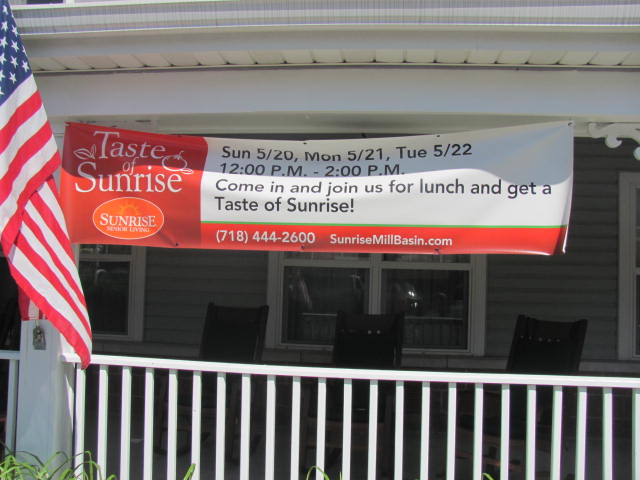
Caryn coordinates speakers for the Taste of Sunrise at Mill Basin events.

Tim Seitz, The World’s Happiest Hypnotist

Miller Calberto, MS, OTR/L Adapting Spaces

George Fehling discusses money management, ramps and lifts for home, business, pool and bathtubs with Occupational Therapy Candidate Kayan Sahadi.

Rev. Dr. Barbara Simpson, Director Of Outreach at Compassionate Care Hospice talks about Keeping Life Positive
Iris Bikel, Attorney & Troy Kirschner, Professional Organizer visit Sunrise at Mill Basin


Iris Bikel, Attorney talks to residents and members of the community about Advanced Directives, Estate Planning and other legal matters.
Troy Kirschner, Professional Organizer chats about de-cluttering and downsizing.
Caryn gives referrals and talks about what to do when the doctors say nothing can be done.
AGINGICON.COM

Have you lived a life of accomplishment, doing what fulfills
you? Have you reached an age where things are harder to do?
Are you a leader and you know that you cannot do it alone?
Then, you are an Aging Icon.
My name is Caryn Isaacs.
Having been at the helm of developing hundreds of healthcare
businesses and running several multi-million-dollar companies,
my journey includes pioneering a physician-owned HMO and
active engagement in Healthcare Reform.
As a Patient Advocate, my company, GetHealthHelp, LLC,
specializes in crafting solutions that enable Aging Icons to
continue pursuing their passions.
An example is a 98-year-old author, playwriter and poet who is
suffering from fibromyalgia and thought that all her work
would be forgotten. I found a way for her legacy to continue by
publishing them as books and now working on having them
made into films.
If this sounds like something of interest, let’s meet to talk
further.
-
Archives
- March 2026 (2)
- February 2026 (2)
- January 2026 (2)
- December 2025 (2)
- November 2025 (1)
- October 2025 (1)
- September 2025 (5)
- August 2025 (2)
- July 2025 (1)
- June 2025 (4)
- May 2025 (2)
- April 2025 (2)
-
Categories
-
RSS
Entries RSS
Comments RSS
 AGING ICON
You must be logged in to post a comment.